Showing posts with label Black & White cinematography. Show all posts
Tuesday, 13 May 2014
Friday, 17 January 2014
Tabu.
Tabu, Miguel Gomes 2012
Tabu would have to be my favourite film from 2013.
At the start of the year I was walking in to my local Palace Cinema and was arrested by the powerful imagery of the large film poster erected at the cinema entrance. It's a beautiful portrait of the young couple and I expected that the actual film may possibly pail in comparison to the poster, but fortunately for the history of cinema, I was wrong.
Tabu is enchanting, mesmerising, and all those cliche terms which tend to induce eye-rolling on my part.
Told in two parts and photographed in black and white (with both parts being shot on different film stock), the film begins ('Paradise Lost') in present-day Lisbon, with the second chapter ('Paradise') moving to mid-century colonial Africa in a village at the foot of Mt Tabu.
Part one follows the daily happenings of Pilar (Teresa Madruga), including her role as caring neighbour to the elderly and troubled Aurora (Laura Soveral). When Aurora becomes critically ill, a man is summoned to her bedside, and his identity is eventually revealed as a long-lost love from Aurora's younger years.
Although the first half of the film is well done, it is the beguiling 'Paradise' which draws you in deeper and takes Tabu to a new realm.
This second part charts the duration of the love affair between Aurora and Gian Luca (now played by Ana Moreira and Carloto Cotta) amid the leafy, humid foothills of tropical Tabu.
Gomes masterfully omits all dialogue from this second part of the film, although leaving all other diegetic sound on track. The audience hears the sounds of the tropics, the rustle of trees, calls of wildlife; and the scratchy sound of '60s rock 'n' roll playing on a turntable. This stylistic choice helped me to actively focus on the characters, reading their faces and body language to decipher emotion, rather than simply listening to a character's dialogue.
A beautifully composed, stylish, nostalgic film with touches of both melancholy and comedy. Aesthetically rich and filled with great beauty, Tabu effectively conveys a strong sense of place, time, young love, and loss.
Tabu would have to be my favourite film from 2013.
At the start of the year I was walking in to my local Palace Cinema and was arrested by the powerful imagery of the large film poster erected at the cinema entrance. It's a beautiful portrait of the young couple and I expected that the actual film may possibly pail in comparison to the poster, but fortunately for the history of cinema, I was wrong.
Tabu is enchanting, mesmerising, and all those cliche terms which tend to induce eye-rolling on my part.
![]() |
| Ana Moreira |
![]() |
| Carloto Cotta |
Told in two parts and photographed in black and white (with both parts being shot on different film stock), the film begins ('Paradise Lost') in present-day Lisbon, with the second chapter ('Paradise') moving to mid-century colonial Africa in a village at the foot of Mt Tabu.
![]() |
| Laura Soveral as Aurora in part one |
Part one follows the daily happenings of Pilar (Teresa Madruga), including her role as caring neighbour to the elderly and troubled Aurora (Laura Soveral). When Aurora becomes critically ill, a man is summoned to her bedside, and his identity is eventually revealed as a long-lost love from Aurora's younger years.
Although the first half of the film is well done, it is the beguiling 'Paradise' which draws you in deeper and takes Tabu to a new realm.
This second part charts the duration of the love affair between Aurora and Gian Luca (now played by Ana Moreira and Carloto Cotta) amid the leafy, humid foothills of tropical Tabu.
Gomes masterfully omits all dialogue from this second part of the film, although leaving all other diegetic sound on track. The audience hears the sounds of the tropics, the rustle of trees, calls of wildlife; and the scratchy sound of '60s rock 'n' roll playing on a turntable. This stylistic choice helped me to actively focus on the characters, reading their faces and body language to decipher emotion, rather than simply listening to a character's dialogue.
A beautifully composed, stylish, nostalgic film with touches of both melancholy and comedy. Aesthetically rich and filled with great beauty, Tabu effectively conveys a strong sense of place, time, young love, and loss.
Friday, 8 November 2013
Brief Encounters of the Loving Kind
Brief Encounter, David Lean 1945
David Lean's Brief Encounter is a powerful film about fidelity, desire, guilt, and hopeless love.
A woman and a man (Celia Johnson and Trevor Howard) have a chance meeting at a train station and gradually fall in love, despite both being happily married with children. Brief Encounter charts the short duration of this intense, passionate, yet restrained love affair.
A definite standout for the film is Celia Johnson's performance, possessing the ability to reveal so much emotion in her eyes. She remarkably portrays the torrid emotions experienced during a loving yet tumultuous relationship which ultimately ends in heartache.
Set primarily on train platforms and in station diners, Lean follows the doomed lovers as they meet on their weekly town outings. Yet these sites of transition are not just a mere setting, their presence used to convey the internal transformation that each character goes through over the course of their affair.
Brief Encounter is a very moving, powerful film that expertly conveys the hypnotic hopefulness of new love, through to the depth and despair of heartache.
Fortunately, throughout November and December the 2013 British Film Festival is featuring special event screenings of the top 5 BFI films, including Brief Encounter, at Palace Cinemas across Australia. A unique chance to witness David Lean's masterpiece on the big screen.
David Lean's Brief Encounter is a powerful film about fidelity, desire, guilt, and hopeless love.
A woman and a man (Celia Johnson and Trevor Howard) have a chance meeting at a train station and gradually fall in love, despite both being happily married with children. Brief Encounter charts the short duration of this intense, passionate, yet restrained love affair.
Celia Johnson and Trevor Howard were paired very effectively, and although the plot covers deeply moving material, the script contains comical moments, particularly from the minor characters.
Brief Encounter is a very moving, powerful film that expertly conveys the hypnotic hopefulness of new love, through to the depth and despair of heartache.
Fortunately, throughout November and December the 2013 British Film Festival is featuring special event screenings of the top 5 BFI films, including Brief Encounter, at Palace Cinemas across Australia. A unique chance to witness David Lean's masterpiece on the big screen.
Friday, 18 October 2013
Saturday, 27 July 2013
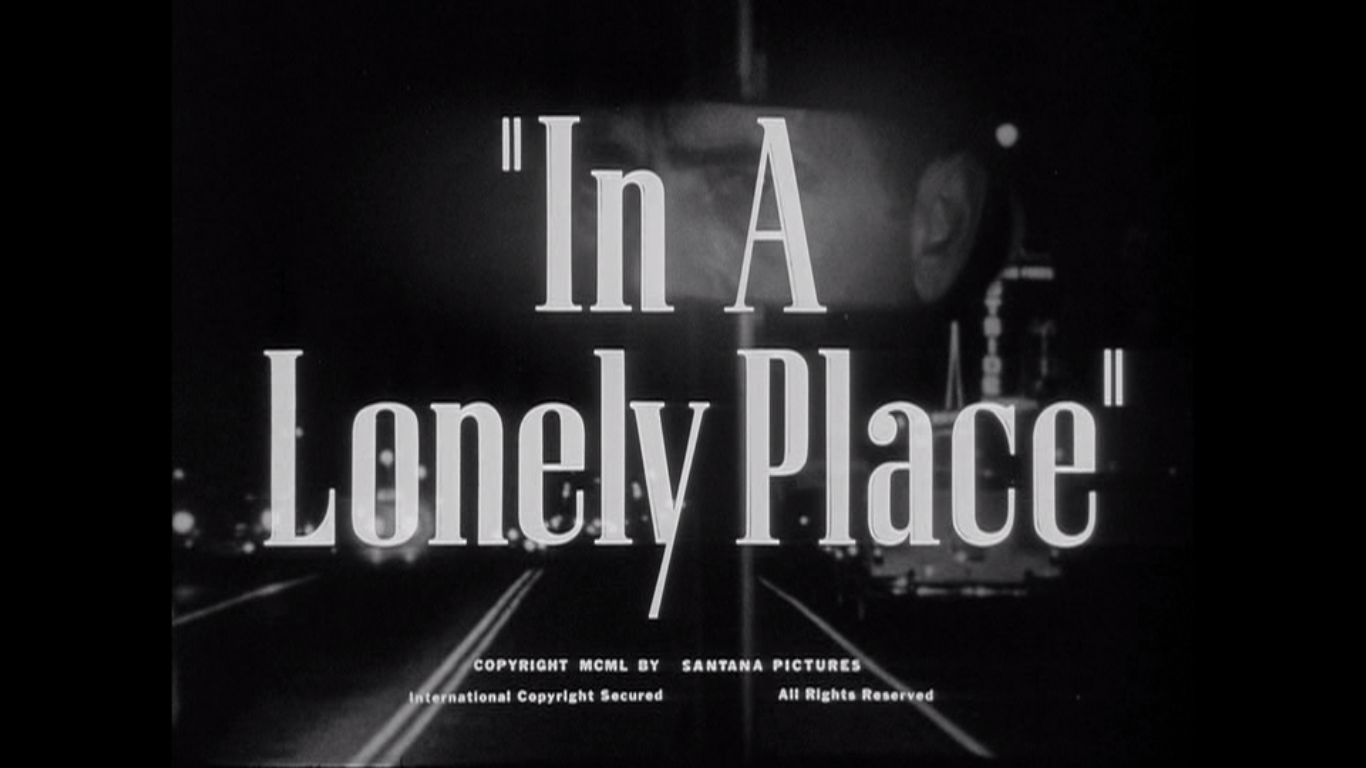
In a Lonely Place
In a Lonely Place, Nicholas Ray 1950
Short-fused screen writer Dixon Steele (Humphrey Bogart) is resolute about only adapting good novels to the big screen, but in need of work he begrudgingly agrees to adapt a trashy bestselling novel although he won't read the book himself - instead paying a cloakroom girl to accompany him home to relay the narrative in her own words. The following morning the woman is found brutally murdered, with Steele seen as the prime suspect, but his new neighbour Laurel Gray (Gloria Grahame) is able to supply the police with an alibi.
The pair quickly develop a passionate love affair but gradually Laurel suspects that her hot-tempered boyfriend subject to fits of rage was actually capable of committing the murder.
![]() |
| Bogart and Art Smith |
![]() |
| Frank Lovejoy |
![]() |
| Gloria Grahame and Humphrey Bogart |
Apart from the fantastic performances from Bogart and Gloria Grahame; the tumultuous suspense-laced love story; cutting dialogue and the bleak insight into the film industry; the set design notably helped heighten the narrative's emotional resonance, I think they were beautifully done.
On a side note, who knew that director Nicholas Ray (well-known for Rebel Without a Cause) studied architecture under Frank Lloyd Wright before moving on to work in Hollywood. I think his background is evident in the way he executes his mise en scene.
![]() |
| "I was born when she kissed me, I died when she left me, I lived a few weeks while she loved me." |
![]() |
| "What does it matter what I think? I'm the guy who tried to talk Selznick out of doing 'Gone With the Wind'." |
![]() |
| Dixon Steele was undoubtedly Bogart's darkest role, and he gives a great performance |
![]() |
| Ray shines a light on Steele's eyes to highlight his seething anger |
Very well written, with three-dimensional characters featuring a dark yet vulnerable Humphrey Bogart in (I think) his best performance, this film addresses the faults of the Hollywood industry. There is a seething cynicism to Bogart's character that keeps building with suspense, and it's just so wonderfully written and played by all actors. It's good to see great actors taking on the gritty roles.
Subscribe to:
Posts (Atom)